






The hourly wage one needs to earn in order to make ends meet continues to rise, according to a new report from the Canadian Centre for Policy Alternatives.
The document looks at a so-called living wage, which is the amount the centre says a person needs to make to afford basic necessities like food and rent.
According to the report, the average living wage in Newfoundland and Labrador has increased to over $27 an hour, up by over seven per cent from the previous year.
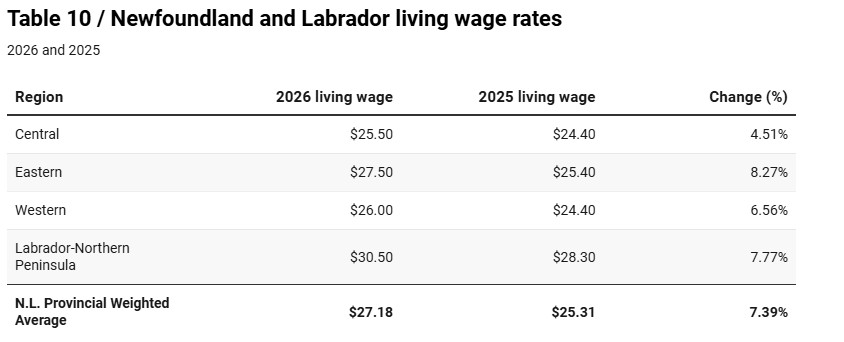
The living wage in NL in 2026 vs 2025 (Canadian Centre for Policy Alternatives)
Broken down by region, the living wage is the lowest in central at $25.50 an hour, it is $26 an hour on the west coast, and $27.50 in eastern Newfoundland.
The wage is at its highest on the Northern Peninsula and in Labrador, however, at $30.50.
Minimum wage is currently $16.35 an hour.
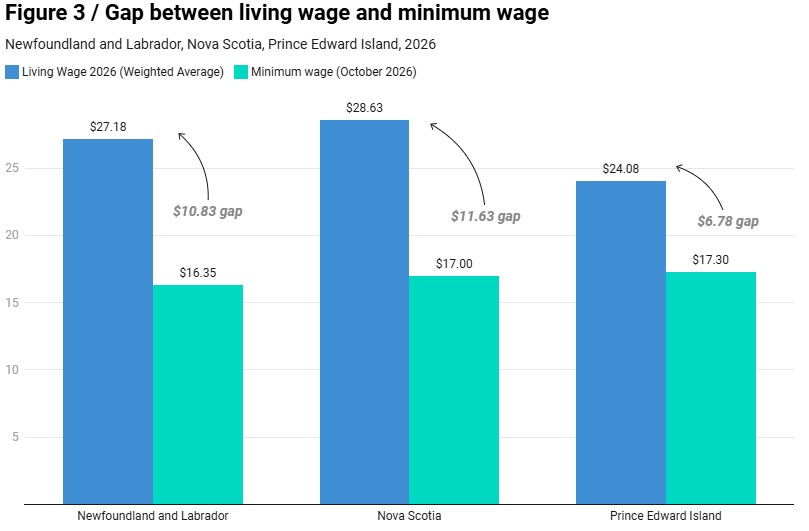
The gap between the living wage and minimum wage in Atlantic Canada (Canadian Centre for Policy Alternatives)
Report co-author and MUN political scientist Russell Williams says inflation is not “evenly distributed” across the population.
He says inflation has “almost systematically attacked…lower income working households.” He says inflation tends to be higher on essentials, and is growing faster than are wages.


